
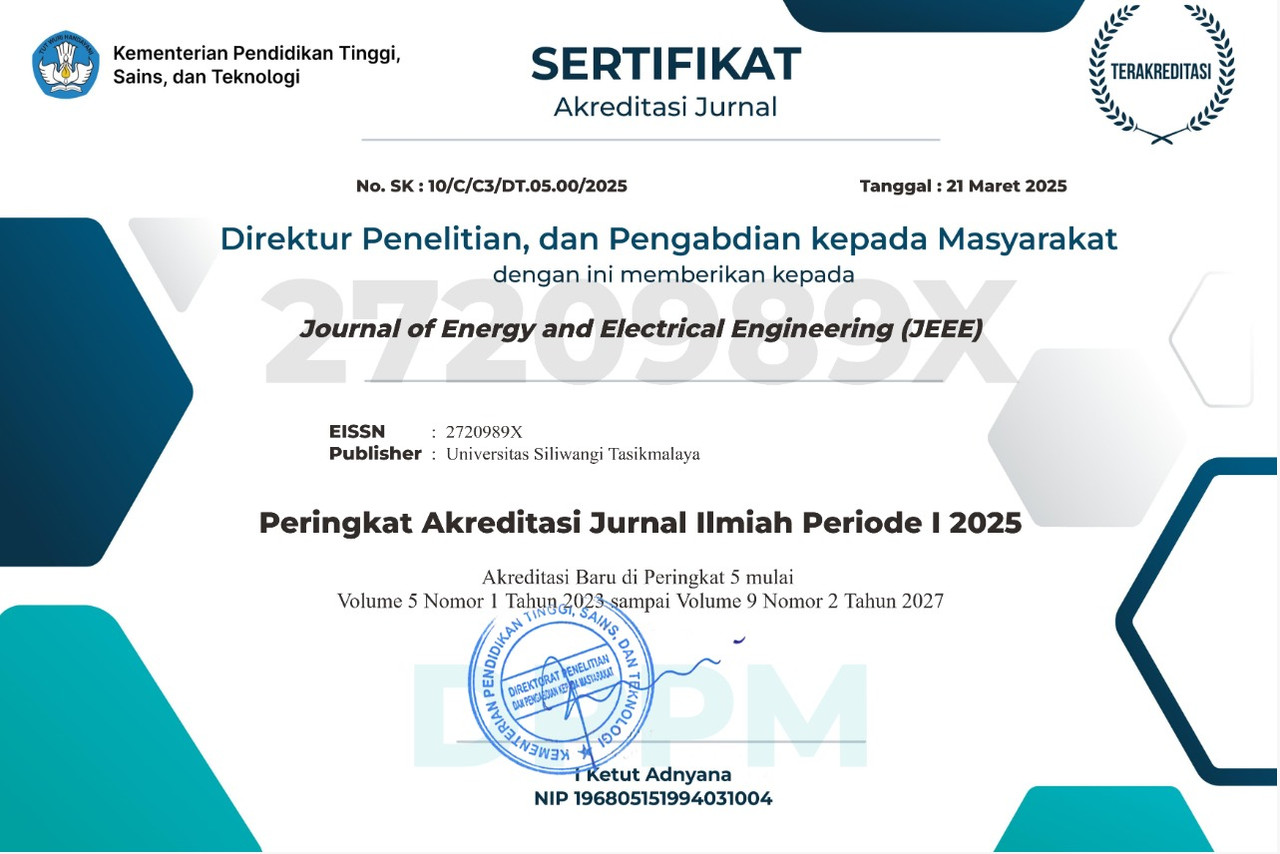










The Journal of Energy and Electrical Engineering (JEEE) is committed to ensuring that authorship accurately reflects scholarly contributions and that every listed author accepts responsibility for the published research. This policy applies to all manuscripts submitted to JEEE and is informed by the recommendations of the International Committee of Medical Journal Editors (ICMJE), the Committee on Publication Ethics (COPE), and the Contributor Role Taxonomy (CRediT).
1. AUTHORSHIP CRITERIA
To qualify as an author, an individual must satisfy all four of the following conditions:
- Make a substantial contribution to the research concept or design, or to the collection, analysis, or interpretation of research data.
- Participate in preparing the manuscript or critically revising its important intellectual content.
- Review and approve the final manuscript version intended for publication.
- Accept accountability for the work and cooperate in addressing questions regarding its accuracy or integrity.
All individuals who meet these criteria should be included as authors. Contributors who do not meet all four criteria should be appropriately acknowledged, with their permission, rather than listed as authors. The order of authors must be agreed upon by the author group.
2. AUTHOR CONTRIBUTIONS
JEEE encourages a clear statement of each author's contribution. Authors may use the CRediT taxonomy to identify the following roles:
- Conceptualization
- Methodology
- Software
- Validation
- Formal Analysis
- Investigation
- Resources
- Data Curation
- Writing - Original Draft
- Writing - Review & Editing
- Visualization
- Supervision
- Project Administration
- Funding Acquisition
One person may have multiple roles, and a role may be shared by several contributors. CRediT describes contributions but does not, by itself, establish eligibility for authorship. All named authors must still satisfy the criteria in Section 1.
3. RESPONSIBILITIES OF THE CORRESPONDING AUTHOR
The corresponding author coordinates communication with the JEEE Editorial Office before, during, and after publication, and is responsible for ensuring that:
- All listed authors meet the authorship criteria and agree to the author order.
- All authors have reviewed and approved the submitted and final versions of the manuscript.
- Author names, affiliations, contribution statements, funding information, and conflict-of-interest declarations are accurate.
- All co-authors are informed of important editorial decisions and requests.
- Questions concerning research methods, data, and publication integrity can be addressed after publication.
4. CHANGES IN AUTHORSHIP
Any request to add, remove, or rearrange authors after manuscript submission must be sent to the Editorial Office with a written explanation and documented agreement from all listed authors and any individual being added or removed. JEEE may request an updated author contribution statement. Where an authorship dispute cannot be resolved by the authors, the journal may seek clarification from the relevant institution. Changes made after publication may require a formal correction notice.
5. UNACCEPTABLE AUTHORSHIP PRACTICES
JEEE does not permit:
- Gift or honorary authorship: naming individuals who have not made sufficient scholarly contributions.
- Ghost authorship: omitting individuals who meet the authorship criteria.
- Adding authors without their knowledge or consent.
- Misrepresenting authors' contributions, affiliations, or responsibilities.
Funding acquisition, general supervision, administrative support, language editing, or proofreading alone does not qualify a person for authorship.
6. USE OF ARTIFICIAL INTELLIGENCE (AI)
AI-assisted tools, including generative AI systems, must not be named as authors or co-authors because they cannot accept responsibility for the work. Human authors remain responsible for the originality, accuracy, citations, and integrity of all submitted content. Relevant use of AI-assisted tools must be disclosed in the manuscript in accordance with the journal's applicable AI policy. Authors should explain how AI tools were used where such disclosure is required.
7. AUTHORSHIP DISPUTES AND EDITORIAL ACTION
JEEE may request supporting documentation when questions arise regarding authorship or contributions. The Editorial Board will review the available information fairly and confidentially. Determination of contested authorship is primarily the responsibility of the authors and, where needed, their institutions. JEEE may suspend editorial consideration while a serious dispute is unresolved and may apply appropriate corrections to the published record in accordance with its publication ethics policies.
8. REFERENCES AND ETHICAL GUIDELINES
- International Committee of Medical Journal Editors (ICMJE). Defining the Role of Authors and Contributors. ICMJE Recommendations.
- Committee on Publication Ethics (COPE). Authorship and Contributorship. COPE Guidance.
- National Information Standards Organization (NISO). CRediT - Contributor Role Taxonomy (ANSI/NISO Z39.104-2022). CRediT Taxonomy.